Some meetings could have been a message. Some messages turn into meetings. And some decisions are so hard to trace that, after a half-hour discussion, no one is quite sure what was agreed.
It's a familiar situation for many teams. As projects grow, so does the need to communicate. Problems begin when we confuse being informed with being in a meeting.
Good communication isn't about how often we talk. It's about getting the right information to the right people when they need it.
Meetings aren't the problem
Meetings matter. Some conversations work much better when everyone is present: resolving a conflict, making a complex decision, exploring ideas, or tackling something that needs different perspectives.
The problem is using meetings for everything.
One meeting to check project progress. Another to remind everyone of outstanding tasks. Another to clarify what was agreed in the last one.
Gradually, coordinating the work starts taking up a significant share of the time available to do it.
Often it's not a lack of communication. It's that information is scattered.
When context is missing, we have to ask
Imagine someone on the team is working on a task and needs to understand why a particular decision was made.
They search their email, scroll through chat messages and ask a colleague. Eventually someone suggests a call to clear things up.
The conversation might take five minutes, but it has interrupted several people's work.
Now imagine that decision, together with the relevant comments and documents, was available right there in the task.
Perhaps the question wouldn't have been necessary at all.
That's what we mean by working with context: keeping the information needed to understand and move a task forward close to the task itself.
It's not about documenting absolutely everything. It's about keeping what may be useful later.
Sharing information is a form of collaboration
We're used to associating teamwork with constant conversations. But collaboration doesn't always mean responding immediately.
Asynchronous collaboration lets people check information, contribute comments and carry on working without everyone needing to be available at the same time.
For example, instead of scheduling a meeting just to review several tasks, we can keep their owners, progress and next steps up to date.
Anyone who needs that information can check it when it suits them.
This doesn't mean getting rid of conversations. It means saving them for the moments when they really add value.
There's another benefit: people who weren't part of a conversation can understand what happened without relying on someone to explain it all over again.
Three habits that help reduce unnecessary meetings
You don't need to radically change the way your team works. Start with three simple habits.
1. Before scheduling, decide what you need
Are you sharing an update, resolving a question or making a decision?
If all you need is to share an update, writing it down somewhere accessible may be enough.
If you need to discuss different options, a meeting may be the best choice.
The key is being clear about the purpose.
2. Keep conversations close to the work
When a comment relates to a particular task, it makes sense to keep it with that task.
That way, important decisions don't get buried among conversations about unrelated topics.
And anyone joining later can catch up without starting from scratch.
3. End every meeting with a clear outcome
A useful meeting should make clear what was decided, who owns each action and what happens next.
You don't need lengthy minutes. A few lines will often do.
What matters is that the result of the conversation doesn't disappear when everyone leaves the video call.
A place for every conversation
At Mopux, we believe organizing work also means organizing the information that goes with it.
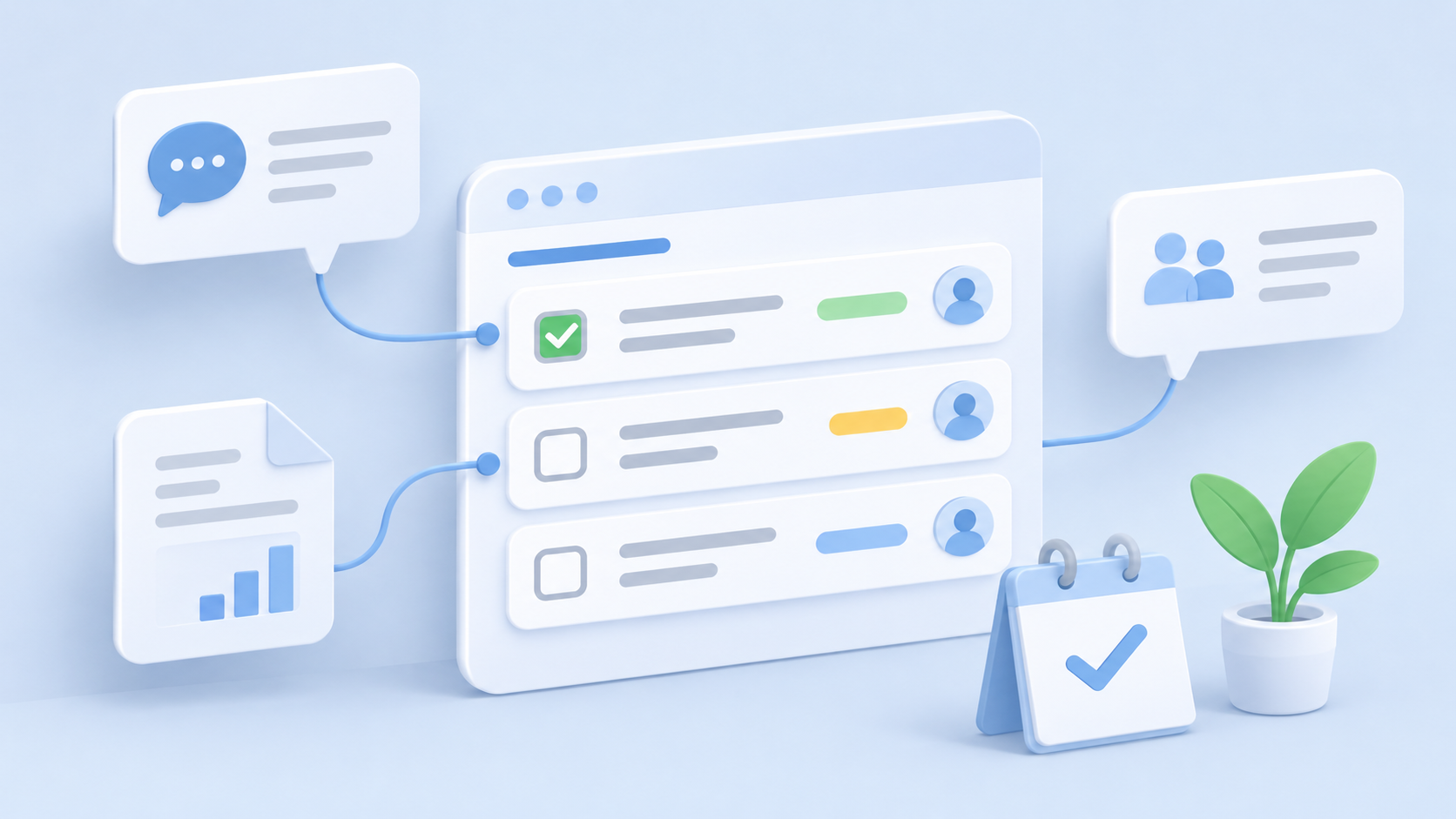
That's why tasks can bring together owners, dates, documents and comments in one place. The goal isn't to replace conversations between teammates, but to help those conversations carry forward.
When information is organized, it's easier to understand what needs doing, what has been decided and how to move ahead.
And when the whole team can access that context, some meetings become unnecessary.
Fewer interruptions, more clarity
This isn't about clearing your calendar completely or turning every conversation into a document.
It's about finding a balance between talking, sharing information and making room to do the work.
A good meeting can unblock a project. A well-documented decision can save you from having the same meeting again next week.
Perhaps the goal shouldn't simply be fewer meetings.
It should be needing fewer meetings to understand what's going on.
 Mopux teamMore ideas for your team ↗